

How Much Revenue Are Missed Calls
A missed call can be a missed repair, replacement, installation, review, referral, and long-term customer. See how to measure the leak—and capture more jobs without living on your phone.

What does one missed call really cost a contractor?
A missed call is not merely an unanswered phone. It can represent the job attached to that call, future maintenance and upgrades, a five-star review, neighborhood referrals, and years of customer value. The first step is to connect missed-call volume, booking rate, close rate, and average job value so the invisible leak becomes measurable.
Key takeaways

A caller is often one of your highest-intent prospects
Someone who calls a contractor usually has a real problem. Their furnace is not working. A pipe is leaking. Their roof may be damaged. They need an electrical repair, a fence estimate, or a tree removed.
That person has already searched for help and compared visible local options, and taken the trouble to call. They are much closer to hiring than someone casually scrolling through social media. That makes the phone call valuable—and voicemail risky.
Immediate need
Active comparison
Marketing already worked
Time is working against you

Turn an invisible phone problem into a measurable revenue number
You do not need complicated software to produce a useful estimate. Start with missed calls, identify how many are genuine prospects, estimate how many would book and close, then multiply by your average job value.
This is an opportunity estimate based on the numbers supplied—not a revenue guarantee. Use the printable audit to compare this estimate with real call activity.
Imagine a contractor misses 12 calls in a week. Eight are genuine prospects. Five would likely book if answered promptly. Three become paying jobs, and the average job is worth $850. That is $2,550 in potential weekly revenue connected to missed calls.
This is not a guarantee that every call would convert. It is a practical way to make a hidden operational problem visible. One replacement, installation, or large project can change the calculation quickly.

The cost extends beyond the first invoice
A satisfied customer may call again for maintenance, repairs, upgrades, or another property. They may leave a review, refer a neighbor, or introduce you to a commercial account. When the first call is lost, that future value may go with it.
Missed calls also create administrative drag: voicemail, phone tag, incomplete notes, forgotten leads, wasted advertising, and evenings spent returning calls after a full day in the field.
Buying more leads will not fix an unanswered-phone problem. It may simply pour more opportunities into the same leak.
The revenue attached to a call is larger than the first transaction. Measure repeat work, reviews, referrals, and administrative time when deciding what reliable call coverage is worth.

Replace the voicemail-only workflow—not the personal service
A better system acknowledges the call immediately, captures useful information, identifies the service needed, and gives the prospect a clear next step. The technology matters less than the outcome: the customer receives help before moving on, and your team receives a complete, organized lead.
Acknowledge immediately
Capture the essentials
Answer routine questions
Book while intent is high
Store the opportunity
Escalate when necessary

Measure the last 30 days before buying more leads
Review the customer journey like an owner and test the response process like a prospect. The purpose is to find the moments where a valuable call becomes invisible, delayed, or forgotten.
- ✓ Count incoming calls that went unanswered.
- ✓ Separate genuine prospects from spam and existing-customer calls.
- ✓ Check how many callers left voicemail.
- ✓ Measure the time until each prospect received a useful response.
- ✓ Count missed calls that became appointments.
- ✓ Identify calls arriving during jobs, evenings, weekends, and peak periods.
- ✓ Record the booking rate, close rate, and average job value.
- ✓ Confirm every qualified call creates a trackable customer record.
- ✓ Review how urgent and high-value opportunities are escalated.
- ✓ Calculate the potential weekly, monthly, and annual revenue at risk.

Missed contractor calls and revenue: common questions
How many missed calls is too many for a contractor?
There is no universal number. The important questions are how many missed calls are qualified prospects, how quickly they receive a useful response, and how much revenue is attached to the appointments you normally book and close.
Will customers leave a voicemail?
Some will, but the business should not depend on it. Many high-intent prospects continue contacting companies until someone answers, acknowledges the need, or offers a clear next step.
Do we need to hire another receptionist?
Not always. The right answer depends on call volume, complexity, hours, and budget. Many contractors combine their existing team with missed-call text-back, organized routing, after-hours coverage, and automated booking for routine inquiries.
Should we spend more on advertising first?
Measure call capture and follow-up first. More advertising can magnify a broken response process. Fixing the leak may produce more booked work from demand you already paid to generate.
How much does a missed call cost a contractor?
The potential revenue cost equals qualified missed calls multiplied by booking rate, close rate, and average job value. The true value can be higher when repeat work, reviews, referrals, and customer lifetime value are included.
How quickly should contractors respond to missed calls?
A qualified caller should receive an immediate useful acknowledgement whenever possible. The response should confirm the request, collect essential details, and offer the correct next step rather than merely promising a later callback.
Can an AI receptionist book contractor estimates?
Yes. A properly configured AI receptionist can answer routine questions, collect service and urgency details, confirm service area, and offer an appropriate estimate or service appointment while escalating complex or high-value calls to a person.
What information should contractors collect from every caller?
Collect the caller’s name, phone number, service address, requested service, urgency, preferred contact method, and the next action promised. Store the information in one trackable pipeline so the opportunity is not scattered across phones and inboxes.
Written and reviewed by Joseph Candela
Build the complete lead-capture system
Turn unanswered demand into trackable opportunities
“Closed a $12,000 HVAC job on a Sunday because the system responded while I was at my kid’s game.”
Danny M. — HVAC contractor, Oakland County
Measure real missed calls before spending more on leads
Download the Webvana 30-Day Missed-Call Audit
✓ Call-capture scorecard and revenue formula
✓ Full-page qualified missed-call log
✓ 30-day action plan with writing space
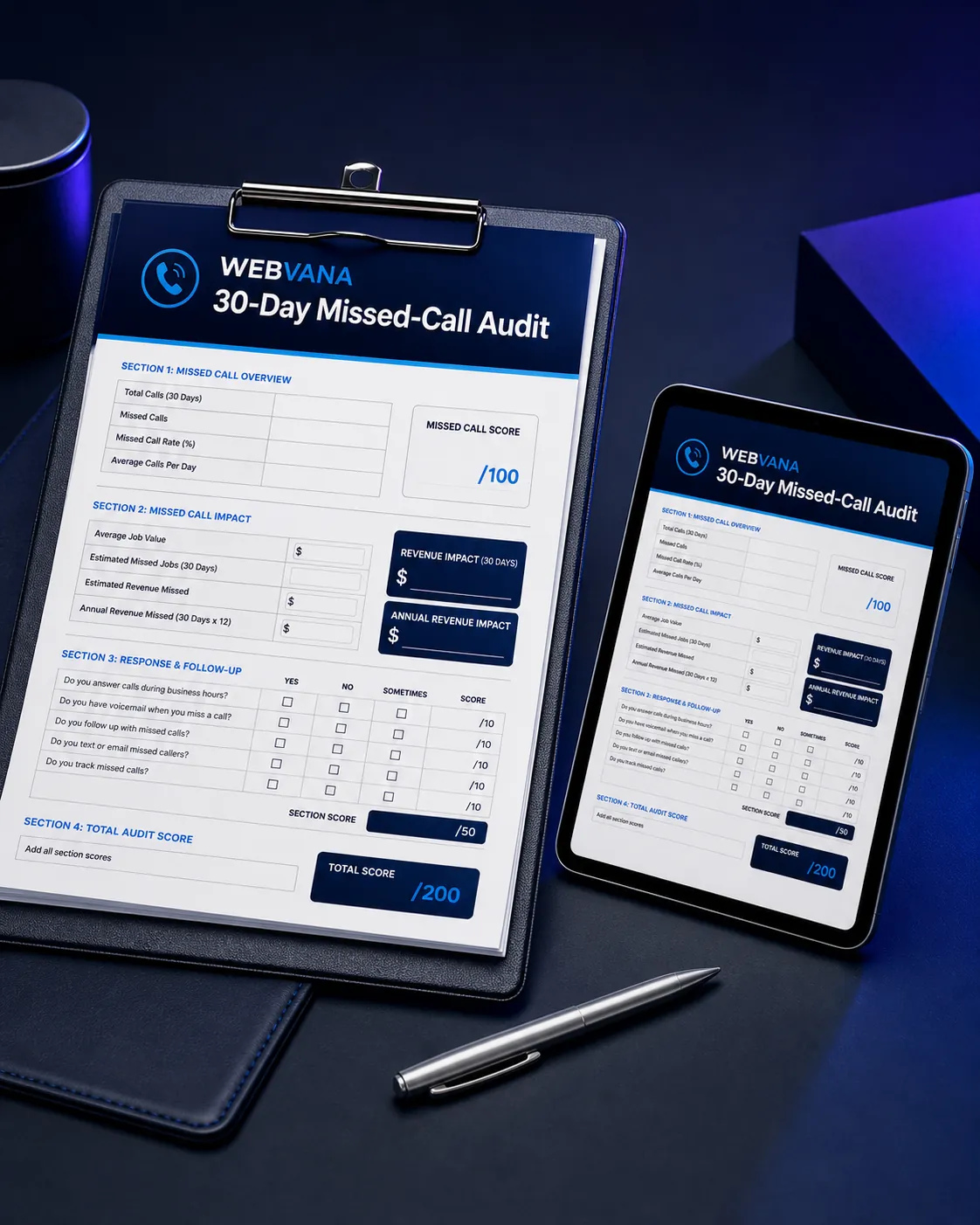
How much potential revenue may be disappearing into voicemail?
Estimate the value connected to missed calls, slow callbacks, and after-hours gaps. You will leave with a clearer view of the problem and practical options for capturing more of the opportunities you already earn.